During long-term operation, transformer oil
gradually ages due to factors such as heat, oxygen, electric fields, and metal
catalysis. So the aged oil must use Transformer Oil Filtration Machine to purify and regenerate the aged oil.
Changes in the following key indicators will directly affect the
safety of the transformer:
Acid Value: Acidic substances are generated during the aging process, causing
the acid value to rise. High acid values can corrode the internal metals and
insulating materials of the transformer, accelerating the aging of solid
insulation. It is one of the early signals of oil failure.
Moisture: Moisture significantly reduces the dielectric breakdown voltage of
the oil and increases dielectric loss. Moisture can also act synergistically
with acids, accelerating the aging of both oil and solid insulation.
Breakdown Voltage: This is a key indicator that measures the oil's ability to
withstand electrical breakdown. Impurities and moisture generated during aging
can form conductive "bridges," significantly lowering the breakdown
voltage. Research indicates that when the acid value reaches 0.2 mgKOH/g, the
breakdown voltage can decrease by 35%.
Dielectric Loss Factor: Reflects the energy loss of oil under an electric
field. Polar impurities generated during aging cause this value to increase,
indicating a decline in insulation performance and increased heating.
Volume Resistivity: Measures the insulating resistance of the oil. Ionic
impurities produced by aging reduce this value, weakening its insulation
performance.
Interfacial Tension: Reflects the oil's ability to repel water. Polar substances
formed during aging lower the interfacial tension, making it a sensitive
indicator of the start of oil deterioration.
Electrification of Oil Flow: Aging intensifies oil flow electrification, which
may cause partial discharge or even breakdown, threatening the lifespan of the
insulation system.
When the oil quality deteriorates to a certain extent, regeneration is
required. The Transformer Oil Filtration Machine with regeneration
process must be carried out cautiously, with the following main points to note:
Pre-Evaluation and Small Sample Tests: Oil quality must be tested before
regeneration to assess the extent of aging. Since different levels of aging
require different processes, small-scale tests should determine the best
process parameters, such as regeneration temperature, type and amount of
adsorbent, etc., to avoid additive loss or side effects.
Selecting the Appropriate Regeneration Process:
Physical Purification: For oil containing a high level of moisture and
impurities, pre-treatment with Transformer Oil Regeneration System can be used.
Adsorption Regeneration: This is a common method, where the oil passes through
a purifier filled with adsorbents such as silica gel or fuller earth, activated
alumina, or granular bleaching earth to remove polar impurities.
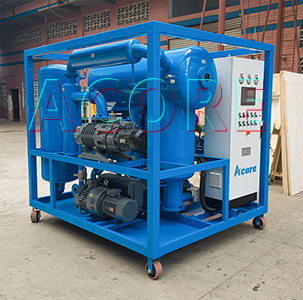
DVTP Transformer Oil Filtration Machine
with regeneration system combines vacuum and regeneration, catering to complex
oil treatments, providing targeted handling of contaminated or aged oil.
Chemical Regeneration: For deeply aged oil, chemical regeneration using
sulfuric acid and bleaching earth can be employed.
Strict Control of Regeneration Parameters:
Temperature: Needs to be tightly controlled, typically recommended around
60-70°C. Excessive temperatures accelerate oxidation of fresh oil, while too
low temperatures affect dehydration and adsorption efficiency.
Vacuum Degree: If vacuum oil filtration is used, a high vacuum (e.g., residual
pressure below 100 Pa) must be ensured to effectively remove moisture.
Post-Treatment Inspection and Storage:
Strict Testing: After regeneration, oil quality must be tested according to
standards to ensure compliance.
Preventing Secondary Pollution: Treated oil should be injected into fully dried
transformers as soon as possible to avoid reabsorbing moisture from the air.
The injection environment should also maintain low humidity (e.g., relative
humidity <60%).
By monitoring key indicators such as acid value, moisture, and breakdown
voltage, the aging status of transformer oil can be effectively assessed. When
regeneration process by transformer oil regeneration system is necessary,
principles such as pre-evaluation, optimal process selection, strict parameter
control, and prevention of secondary pollution should be to ensure
processing effects and equipment safety.





 +8613206063693
 Rufus Huang
 sales@acorefiltration.com
 +8613206063693
 +86 23 8132 4618
